Pages

Tuesday, February 14, 2017

"Lesson Plan"


Some teacher friends and I were recently discussing our first year teaching.  How utterly bad we were! Last week I attended a writing conference during which we were told to write an apology poem.  Recalling my earlier conversation with my colleagues, I chose to write an apology to my first English class back in 1997.
--------------------------------------------------------------------------------------------

I’m always afraid of my first English class showing up on my doorstep.

The most peaceful place I had ever been was on the fourth floor
of the Mullen Library at Catholic University.
My only worry was getting Keats just right
amid the dusty silence of stacks of first editions
and unread dissertations.
Back in 1997 though there was no peace,
just a sea of hormonal 14-year-old boys
quoting South Park with scholarly precision.

I’d forgotten until now how lost I was at the front of that class,
ignorant of the fact that I didn’t need all the answers,
that the perfect lesson plan had nothing to do
with helping kids enjoy Juliet’s strength,
Scrooge’s conversion, or the powerful voices
laying dormant in their teenage pens.

I come from a long line of people who had no time to read,
waitress-matriarchs, unit managers at the General Electric’s gear plant,
fire-fighters who worked two jobs to make ends meet.
My relatives would have been uncomfortable sitting in my first classroom.
My grandfather’s thick Polish frame would have chaffed at the edge
of the tiny desk - he preferred to read on his couch,
biographies of Patton and MacArthur.
His big blue eyes would have rolled at my stupid presentations
on nouns and narrative voice.
My two grandmothers would have left the classroom
the minute I told them they couldn’t smoke.
They’d all be proud I had a job that required a tie.

If I had only realized that my first class, and every class after,
was just a group of people discussing books
and discovering who they were with a pen.

I’d like to tell them I’m sorry - Chris Ritchie, Ben Martin,
Andrew Goodwin, Paul Tortorici, Chris Ferguson,
and the rest of my first class.
I didn’t know how to be 23 and be a real teacher.
I’m sorry I didn’t listen more rather than just try to be smart.

And I’m sorry I didn’t know how to get out of the way.

Thursday, November 3, 2016

"Someday We'll All Be Kings" - A Short Story Inspired by Shakespeare's 29th Sonnet


Link

 
A boy crosses the room during the beginning of class, backpack over his shoulder, the hair in his eyes masking the indifference he bears to his own lateness.  You’ve begun discussing Shakespeare’s 29th sonnet, imagining what it must feel like to be able to feel like this, and you notice how the boy takes his time dragging his boots across the floor towards his desk by the window.
            “When in disgrace with fortune and men’s eyes,
            I all alone beweep my outcast state . . .”

He gazes out at the street, the art building, the passing cars, the rain, looking more through these things than at them.  It’s like you’re not there.

            “And trouble deaf heaven with my bootless cries . . .”

For twenty years you have taught sonnet 29, your favorite poem, enjoying its jazz-like rhythmic improvisations and the wonderful optimism in the face of life’s adversity – “and then, like to the lark at break of day arising from sullen earth, haply I think on thee.”  You wish a turn of phrase so brilliant would knock on your door and make things better.

You try to ignore the sullen, long-haired boy against the window, but it’s hard.  You want them all to realize how amazing this poem is, how such feelings are almost impossible in real life, how sometimes poetry is as real as life is, or as real as you’d like it to be.  You don’t know the boy lives with his grandmother.  You aren’t there at her kitchen table, day after day, as she reads her favorite recipes to him.  Apple pie, chicken and dumplings, tuna noodle casserole.  Her only resume. You don’t see him listen lovingly, every night, to this litany of ingredients, only returning to his room when she rises from the table.

You return to the poem, focusing on its wonderful music, its varieties of the iambic pentameter line.  You’re happy because you can chart this all out on the board, looking smart, the master decoder demystifying a 400 year-old poem for a bunch of kids who, maybe, if you decode it just right, will really get it.  But you ignore the fact of the poem’s words – “this man’s art, that man’s scope,” “men’s eyes,” “cursing my fate.”  You don’t ask if anyone has ever felt this because it would be like getting too close to the flame.  You pay attention to the metaphors, the beats, the prosody because they are harmless and measurable - - topics for impressive essays – the pain and longing too real to acknowledge as you try to look smart before your class. 

You wish you were as courageous as the scowling boy, whose last short story was confused for a memoir and who bore his soul like he was writing on his deathbed – with no sense of audience or repercussions – the petty crimes, the shattered glass on the kitchen floor, the stench of cheap whiskey, the countless hours alone with his XBOX, the half-written suicide notes crumpled in his garbage can, the memory of his first-day-of-school Kindergarten picture on the living room wall – a picture full of toothless joy, a story with only one chapter.  He wrote all of this down.  You didn’t give it a grade.  For once, you had good sense.  It would have been obscene to pretend that his pain could fit inside a number in red ink.  You wrote “SEE ME” in bold confident letters but the boy had neither the boldness nor confidence to see you on his own.  Strangely, you haven’t found the courage to see him either.  You wonder for a moment the conditions under which you would “change your state for kings” and what you would change it for.  No, that’s wrong.  Shakespeare isn’t saying that, you realize.  He’s saying that his beloved is so amazing that even though he is envious, jealous, and talentless, the love he has isn’t worth changing anything for.  You ponder Shakespeare’s boldness for shooting for the moon.  “Kings.”  He wouldn’t exchange his shitty life, EVEN to be a king, as long as his beloved stays by his side.

The bell rings, wishing your thoughts could be part of your lesson plan.  You drive home to a silent house.  The only sounds are the voices of Pat Sajak and Alex Trebek before you retire early for the night.  Even in your last waking moments, even in your dreams, you never realize that the boy sits in the dark with his Xbox, the sounds of simulated gunshots muting any hope for cosmic deals, for images of greatness, even for the desire for someone to grab his hand and say, “I am here.  I am here.”

Wednesday, October 19, 2016

A Nameless Woman Silences Heroes: The Surprising Thoughtfulness of "Beowulf"


When I was a little boy, my friends and I would play “Star Wars.”  We would take turns being either Luke Skywalker and Han Solo or the villains Darth Vader and the Storm Troopers.  Even though we were five, we innately understood the rules of the game.  Good guys were noble, loved flying in land-speeders and space ships and enjoyed employing their favorite catchphrases at critical moments (“May the force be with you!”).  Darth Vader breathed heavily and had magical powers while the faceless Storm Troopers killed anything that moved (and, fortunately, had atrocious aim!).  But we understood the rules of the game and there was no ambiguity.

One of the reading challenges of the epic Beowulf is that the rules of the poem are always shifting.  The most important “rule” is the clear expectations of the good king.  A “good king” in the beginning of the epic is a man who rules by intimidation (not fighting AS king) and who gives generously to the heroes closest to him.  The good king manages a community and gives away gold. 

Near the end of the poem, Beowulf the king battles a dragon that has terrorized his people.  The poet next moves the conversation to the emotional level and imagines not only the details of the dragon’s hoard but also the dragon’s feelings towards his riches.  Like all dragons, the dragon of this epic obsessively values his immense hoard of treasure.  The poet calls this feeling in the dragon hord-wynne (hoard-joy) – the perverse affection for gold.  Tolkien, in The Hobbit, calls this “dragon sickness.”  This is the root of the dragon’s evil.  “Good” behavior in this poem is signaled by generosity, not hoarding. 

Beowulf manages to kill the dragon and acquire the dragon’s extensive wealth but dies after the fight.  Beowulf utters his final words and his speech is not a prayer, not an expression of gratitude to his people, but rather a desire to see that “ancient gold” for which he has died.  We are left to wonder if the rules for a “good king” still apply, whether Beowulf has redefined the notion of “good king,” or whether he will use these new riches to reward his men.  The poet does not make us wait long for an answer.  Near the end of the poem we are told that the newfound material wealth is buried under ground, “as useless to man as it ever was.”  The rules are changing.

 https://blogger.googleusercontent.com/img/b/R29vZ2xl/AVvXsEh4_XdUosuXswABjSww4ZOENe-Wpiq07rBA_Ld3zU9ZP6uNKY3yA3T4KA0B0J2G9jJU_FrVbri9afjmrdVP0IHIi6l0yumpwYtQQzHVoTIsGFqHSCeQqc4XQ6aVbJ9cyL4YVEIflDSewr0/s1600/beowulf2.jpglink

He behaves as a warrior when he should be behaving like a king, and the smoke of his heroic funeral pyre is still rising when a nameless woman of his tribe yells out a truth never heard in epic poetry.  The poet tells us that she:

         . . . sang out in grief;
         with hair unbound, she unburdened herself
         of her worst fears, a wild litany
         of nightmare and lament, her nation invaded,
         enemies on the rampage, bodies in piles,,
         slavery and abasement.  Heaven swallowed the smoke.

This is the price of kings who forget themselves: nameless people suffer.  This woman reminds us of the cost of reckless leadership and a martial ethic that is less a solution and more a never-ending circle of blood.  The progression of her nightmare is chronological and telling, from invasion to rampage to body-count to slavery to the seeming indifference of heaven. How many women in Syria could utter these exact words today? 

I often wish that this woman were given a name and, equally importantly, her own words (rather than a paraphrase).  But she might be the most important nameless character in medieval literature for her voice uniquely exposes a heroic code that is clearly losing ground.  The rules of the poem and the world it represents are changing. Gold is an ultimately empty rationale for risking one’s life.  Perhaps this nameless woman, lost in the shadow of myth, reminds us that such “hoard-joy,” such a blatant embrace of materialism, does not lead to immortality or even short-term safety but rather the cycle of violence that provides the only stable rule in the poem.

Tuesday, October 11, 2016

Beowulf is min nama: Some Thoughts on Beowulf, l. 1-835


https://i.kinja-img.com/gawker-media/image/upload/s--6KCgwZON--/c_fit,fl_progressive,q_80,w_636/gy6kymhdohgmewn5cgle.jpg
Link
To read deeply and dynamically means, among other things, to embrace the exciting fact that each new book defines its own terms and offers its own rules for reading itself.  A good man in Hamlet is different than a good man in The Importance of Being Ernest, for example.  Heroism in The Iliad is dynamically different that heroism in The Things They Carried.  And so is the case with this complex, mysterious poem.  Our first job is that we need to learn each book's own rules.  What are the rules, the 'operating manual,' for Beowulf?

On the first page of Beowulf, we know quite a bit.  We know, for example, the poem’s definition of a good king (god cyning), one who has gifts in his hand for his kin and a bloody sword in his hand for his enemy.  We know that a person’s identity is inextricably bound to the behavior of his lineage before him.  No one is “his own man;” his identity, as a result, is largely out of his control.  We know the leader of the Danes - Hrothgar -  embodies the kingly traits of warrior par excellence and generous gift-giver as defined in the poem.

As the pages continue and we learn of Hrothgar’s many successes, we learn about the poem’s definition of a villain.  We meet Grendel and we are given a dynamic portrait of evil, the “good king” flipped on its head. 

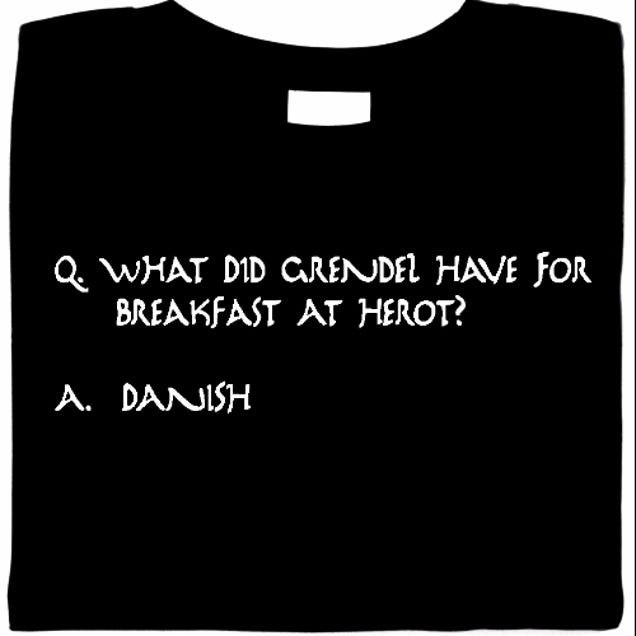
Literally speaking, Grendel is the monster that has decimated the Danes’ mead-hall and gruesomely killed many of their best men.  Grendel only lives for about 20 pages (yet ravages the mead hall for over a decade) but he is as interesting as any villain created in the last 100 years.  He is not merely a “monster” as he is often called in translation.  He is in Caines cynne (“in the line of Cain” - l. 107) and is thereby genetically connected to the father of weapons, murder, and fratricide.  The Cain connection is essential here, making Grendel the worst nightmare this poem can conjure because kin-killing is in his DNA.  In this poem, warriors needed to utterly trust in the loyalty of their fellow warriors and their kin.  Breakdowns in this system did not lead to a psychological insecurity but, rather, death itself.  Grendel is also an Ellen-gaest (86) or a “powerful demon” or “powerful stranger.”  He moves like a villain and is called Earfothlice (86) – a prowler.  He is Feonde on helle (100)–a fiend/enemy out of hell (a place as real to this poem's audience as Boston or New York is to us!).  Grendel is Eotonas (112) – an Ogre, the Old Norse creature who was the giant, monstrous undead, human but larger and cannibalistic.  He was preternaturally huge (gigantas – l. 113) and, perhaps most disturbing of all was that he was an Orcneas (112), an evil phantom (from Old Norse “ne” – corpse, eotenas “to eat” – hence “corpse eater” – later reformed into Tolkien’s “orc”).  And the true sign of Grendel’s evil (as if corpse-eating wasn’t enough!) is that Grendel lives out the most horrifying of Anglo-Saxon fates.  He is alone, an An-gengea (165) – literally “one who goes alone” or “solitary one.”  All of this information lives on a couple pages in the poem and describes just one of the poem’s three key villains.  We know his spiritual lineage and his solitude, his size, his diet, and even how he moves, each of these details adding another layer of evil to an already self-evident villain.

In just a handful of manuscript pages, lines are being drawn.  We know the poem’s standard for a good king and also for the objective villain.  At this point, any rational reader would occasionally glance at the cover of the book and wonder, where is the title character?

When we finally meet Beowulf, we are not given the depth of information that we get with the good king or the murderous monster.  In the first quarter of the poem, we meet Beowulf, hear him speak persuasively and see him fight and behave like a hero.

But unlike most narratives in which the hero has the deepest backstory, Beowulf, who has the strength of 30 men in each arm, remains a mystery.  He tells heroic tales of his youth that are uncorroborated.  We know his father’s name but he has no wife, no children, and his king has mysteriously let him go on this strange search-and-destroy mission on behalf of another people.  Beowulf has no authority and deep lineage (like King Hrothgar) and no nuanced personality and set of traits (like Grendel). 

Beowulf finally identifies himself to the Danish coast guard when he bluntly states, “Beowulf is min nama” (“Beowulf is my name”).  I can’t help but to wonder that the poet had a clear understanding of what made a good king and a convincing villain but perhaps didn't exactly know what to make of this Beowulf.  Or maybe this is an early example of the poet wanting the auidence to create its own definitions along the way, to help shape the poem in the listening.  The poet of the mead-hall was called the ‘shaper’ (scop) after all.


Thursday, October 6, 2016

Passing By: A 100 Word Story


bus-1209153_640
link


Malboro Lights.

$10 a pack.

My one pleasure.

Looks like rain.

Should put away the porch chair.

Dark sky for miles.

Fall in the air.

All those cold Saturdays at the football field.

Cheer-leading.

Yelling, dancing and twirling.

No one heard us.

Team went 1 and 14.

Should have stayed home, mom said.

Mom’s cough, the phlegmy chorus of my 30s.

Now her bedroom stores my photo albums, my winter clothes, 
         and the baby carriage.

Empty.

16th floor.

So close I could spit on that train.

Instead, I flick my cigarette, hoping it jolts someone who’s on their way somewhere.


Saturday, September 3, 2016

Send Error Report


My computer is so polite,
its binary kindness
pressed into a little square
asking me to SEND ERROR REPORT?

I imagine some poor intern at a desk
rubbing sleep from his eyes,
wiping coffee stains from his plain white dress shirt.

No SAT tutor,
spelling errors on his admissions essay,
“Call of Duty” instead of Organic Chemistry.

He slouches behind the unfortunate desk –
a sad mockery of the desks he ignored in college,
next to the tired single mother happy to work
in the quiet predictability of an office.

Children dream of being astronauts,
famous baseball players, doctors, and princesses.
Cheering crowds and large mansions furnish
our youthful imaginations,
adventures in far-away lands,
a world of endless surprise,
leaving the boring jobs
to kids who don’t have the luxury of their own dreams.

No little boy tells his teacher –
when I grow up I want to be the ‘SEND ERROR REPORT’ guy,
a job that has never been discussed
in the glitter-and-glue world of first grade.

I was always told that I would have to pay for my mistakes.
I will never understand the “Error” I made
but I am glad that it is now someone else’s problem,
someone reading my screen in anger
in an office I will never see.

Thursday, June 2, 2016

My Son, Achilles


I wrote this poem while half reading Fagles' translation of "The Iliad" and half watching my son at fencing practice.  It struck me that my son has a rich inner life, contrary to the stereotypes about young boys.  I can imagine him in an ancient epic, needing time to think about what is going on.  I saw him carefully put on his fencing gear on his way to a simulated battle and I began to write this poem.

******

My son, like Achilles, is not one for team sports.

He jumps in the car on the way to play practice,
pounces on his bike to cruise the neighborhood
like a 10-year-old James Dean.
But the appeal of team sports has always eluded him.

Like the Achaean hero, he stews over the 5th grade cheater,
privileges promised and not received,
the countless schoolyard injustices.
He slinks away to his videos, his Legos, and his solitude
as the battles rage on without him.

Maybe that’s why he enjoys fencing,
the ceremonial dressing for combat,
the bobbing and weaving on his own wine-dark sea
as he imagines avenging the death of his Patroclus
while the god who moves lightning
bellows for the class to do 30 push-ups,
my son, hands and toes on the mat,
surrendering to the gods once more.